Lords She Belongs to Me on the Road Again
| Bringing Information technology All Back Home | ||||
|---|---|---|---|---|
 | ||||
| Studio album by Bob Dylan | ||||
| Released | March 22, 1965 (1965-03-22) | |||
| Recorded | January 13–15, 1965 | |||
| Studio | Columbia Studio A & Studio B, New York City | |||
| Genre |
| |||
| Length | 47:21 | |||
| Label | Columbia | |||
| Producer | Tom Wilson | |||
| Bob Dylan chronology | ||||
| ||||
| Singles from Bringing It All Back Home | ||||
| ||||
Bringing It All Back Abode (known as Subterranean Homesick Blues in some European countries) is the 5th studio anthology by American singer-songwriter Bob Dylan. It was released on March 22, 1965, by Columbia Records.
The outset one-half of the anthology features electric songs, followed by mainly acoustic songs in the 2d half. The anthology abandons the protestation music of Dylan'south previous records in favor of more surreal, complex lyrics.[5] On side one of the original LP, Dylan is backed by an electric rock and roll ring—a motion that further alienated him from some of his former peers in the folk music community.[6]
The album reached No. 6 on Billboard 'southward Pop Albums chart, the get-go of Dylan's LPs to suspension into the United states top 10. Information technology also topped the UK charts afterwards that spring. The first track, "Subterranean Homesick Dejection", became Dylan's kickoff unmarried to chart in the US, peaking at No. 39. Bringing Information technology All Back Home has been described as one of the greatest albums of all time by multiple publications.
Recording [edit]
Dylan spent much of the summer of 1964 in Woodstock, a small town in upstate New York where his manager, Albert Grossman, had a place. When Joan Baez went to meet Dylan that August, they stayed at Grossman'south business firm. Baez recalls that "most of the calendar month or so we were there, Bob stood at the typewriter in the corner of his room, drinking red vino and smoking and tapping away relentlessly for hours. And in the dead of nighttime, he would wake up, grunt, grab a cigarette, and stumble over to the typewriter once again." Dylan already had ane song ready for his side by side album: "Mr. Tambourine Human" was written in Feb 1964 but omitted from Another Side of Bob Dylan. Another song, "Gates of Eden", was also written earlier that yr, appearing in the original manuscripts to Some other Side of Bob Dylan; a few lyrical changes were eventually fabricated, only it's unclear if these were fabricated that August in Woodstock. At to the lowest degree ii songs were written that month: "If Yous Gotta Get, Become Now" and "It's Alright Ma (I'thou Only Haemorrhage)". During this time, Dylan's lyrics became increasingly surreal, and his prose grew more stylistic, frequently resembling stream-of-consciousness writing with published messages dating from 1964 condign increasingly intense and dreamlike as the year wore on.
Dylan returned to the metropolis, and on August 28, he met with the Beatles for the first time in their New York hotel.[7] In retrospect, this meeting with the Beatles would prove to be influential to the direction of Dylan's music, as he would presently record music invoking a rock sound for at least the next iii albums. Dylan would remain on good terms with the Beatles, and equally biographer Clinton Heylin writes, "the evening established a personal dimension to the very existent rivalry that would suffer for the remainder of a momentous decade."
Dylan and producer Tom Wilson were shortly experimenting with their ain fusion of rock and folk music. The beginning unsuccessful examination involved overdubbing a "Fats Domino early stone & whorl affair" over Dylan's earlier, acoustic recording of "Firm of the Rising Sun", co-ordinate to Wilson. This took identify in the Columbia 30th Street Studio in December 1964.[8] Information technology was quickly discarded, though Wilson would more famously use the same technique of overdubbing an electric backing track to an existing acoustic recording with Simon & Garfunkel'southward "The Audio of Silence". In the concurrently, Dylan turned his attention to another folk-rock experiment conducted past John P. Hammond, an old friend and musician whose father, John H. Hammond, originally signed Dylan to Columbia. Hammond was planning an electric album around the blues songs that framed his audio-visual live performances of the time. To do this, he recruited three members of an American/Canadian bar band he met one-time in 1963: guitarist Robbie Robertson, drummer Levon Helm, and organist Garth Hudson (members of the Hawks, who would proceed to become the Band). Dylan was very aware of the resulting anthology, So Many Roads; according to his friend, Danny Kalb, "Bob was actually excited almost what John Hammond was doing with electric dejection. I talked to him in the Figaro in 1964 and he was telling me about John and his going to Chicago and playing with a band and and then on …"
Yet, when Dylan and Wilson began work on the next album, they temporarily refrained from their own electrical experimentation. The commencement session, held on January thirteen, 1965 in Columbia's Studio A in New York, was recorded solo, with Dylan playing pianoforte or acoustic guitar. Ten consummate songs and several song sketches were produced, nearly all of which were discarded. Take one of "Bob Dylan's 115th Dream" would exist used for the album, but three would eventually be released: "I'll Go on Information technology With Mine" on 1985's Biograph, and "Goodbye Angelina" and an audio-visual version of "Subterranean Homesick Dejection" on 1991'southward The Homemade Series Volumes one–3 (Rare & Unreleased) 1961–1991.
Other songs and sketches recorded at this session: "Love Minus Zero/No Limit", "It'due south All Over Now, Baby Blue", "She Belongs to Me", "On the Road Again", "If You Gotta Become, Go Now", "Y'all Don't Have to Do That", "California," and "Outlaw Dejection", all of which were original compositions.
Dylan and Wilson held another session at Studio B the following day, this time with a full, electric band. Guitarists Al Gorgoni, Kenny Rankin, and Bruce Langhorne were recruited, equally were pianist Paul Griffin, bassists Joseph Macho, Jr. and William E. Lee, and drummer Bobby Gregg. The solar day'due south work focused on eight songs, all of which had been attempted the previous mean solar day. Co-ordinate to Langhorne, there was no rehearsal, "we just did first takes and I remember that, for what it was, it was amazingly intuitive and successful." Few takes were required of each song, and after iii and a half hours of recording (lasting from 2:30 pm to 6:00 pm), chief takes of "Honey Minus Nothing/No Limit", "Subterranean Homesick Dejection", "Outlaw Dejection", "She Belongs to Me", and "Bob Dylan'due south 115th Dream" were all recorded and selected for the last album.
Sometime after dinner, Dylan reportedly continued recording with a different gear up of musicians, including John P. Hammond and John Sebastian (only Langhorne returned from before that day). They recorded six songs, only the results were deemed unsatisfactory and ultimately rejected.
Another session was held at Studio A the next day, and it would be the final one needed. In one case over again, Dylan kept at his disposal the musicians from the previous day (that is, those that participated in the 2:xxx pm to 6:00 pm session); the one exception was pianist Paul Griffin, who was unable to attend and replaced by Frank Owens. Daniel Kramer recalls:
The musicians were enthusiastic. They conferred with one some other to work out the issues as they arose. Dylan bounced around from one man to another, explaining what he wanted, often showing them on the pianoforte what was needed until, like a giant puzzle, the pieces would fit and the flick emerged whole … Almost of the songs went down easily and needed only three or four takes … In some cases, the starting time have sounded completely different from the final one because the textile was played at a different tempo, peradventure, or a different chord was chosen, or solos may have been rearranged...His method of working, the certainty of what he wanted, kept things moving.
The session began with "Maggie's Farm": only ane take was recorded, and it was the just one they'd ever need. From there, Dylan successfully recorded master takes of "On the Route Again", "It's Alright, Ma (I'one thousand Only Bleeding)", "Gates of Eden", "Mr. Tambourine Homo", and "It's All Over Now, Babe Bluish", all of which were set up bated for the album. A principal accept of "If You Gotta Go, Go Now" was also selected, but it would non exist included on the anthology; instead, information technology was issued as a unmarried-only release in Europe, only not in the US or the United kingdom.
Though Dylan was able to record electric versions of most every song included on the final album, he obviously never intended Bringing It All Back Home to be completely electric. As a result, roughly half of the finished album would feature total electrical band arrangements while the other half consisted of solo acoustic performances, sometimes accompanied by Langhorne, who would embellish Dylan'south audio-visual performance with a countermelody on his electric guitar.
Songs and themes [edit]
The album opens with "Subterranean Homesick Dejection", heavily inspired by Chuck Drupe's "Likewise Much Monkey Business". "Subterranean Homesick Blues" became a Top 40 striking for Dylan. "Snagged by a sour, pinched guitar riff, the song has an acerbic tinge … and Dylan sings the title rejoinders in mock self-pity," writes music critic Tim Riley. "It'south less an indictment of the organisation than a curl of imagery that spells out how the system hangs itself with the rope information technology's and so proud of."
"She Belongs to Me" extols the bohemian virtues of an artistic lover whose creativity must be constantly fed ("Bow downwardly to her on Sunday / Salute her when her altogether comes. / For Halloween buy her a trumpet / And for Christmas, give her a drum.")
"Maggie's Subcontract" follows a straightforward blues structure, with the opening line of each verse ("I own't gonna work...") sung twice, then repeated at the cease of the verse. The 3rd to fifth lines of each poesy elaborate on and explicate the sentiment expressed in the poetry'south opening/closing lines.
"Love Minus Nothing/No Limit" is a love song. Its primary musical hook is a series of iii descending chords, while its lyrics clear Dylan's feelings for his lover, and accept been interpreted every bit describing how she brings a needed zen-like calm to his chaotic world. The song uses surreal imagery, which some authors and critics accept suggested recalls Edgar Allan Poe's "The Raven" and the biblical Volume of Daniel. Critics have also remarked that the manner of the lyrics is reminiscent of William Blake'southward poem "The Sick Rose".
"Outlaw Blues" is an electric blues song that lyrically follows a fugitive traveling through harsh conditions ("Own't it hard to stumble and country in some dirty lagoon? Peculiarly when information technology's 9 below zero and three o'clock in the afternoon.") as he resents the life of being on the run.
"On the Road Once more" catalogs the absurd affectations and degenerate living atmospheric condition of bohemia. The song concludes: "So you ask why I don't alive hither / Dear, how come y'all don't movement?"
"Bob Dylan'south 115th Dream" narrates a surreal feel involving the discovery of America, "Captain Arab" (a clear reference to Captain Ahab of Moby Dick), and numerous bizarre encounters. It is the longest song in the electrical department of the anthology, starting out as an audio-visual ballad before existence interrupted past laughter, and so starting dorsum up again with an electric blues rhythm. The music is so similar in places to Another Side of Bob Dylan's "Motorpsycho Nitemare" as to be indistinguishable from information technology but for the electric instrumentation. The vocal can be all-time read equally a highly sardonic, non-linear (historically) dreamscape parallel cataloguing of the discovery, creation and merits (or lack thereof) of the United States.
"Mr. Tambourine Human" is the showtime track on side 2 of the anthology. Information technology was written and equanimous in early 1964, at the aforementioned judge time as "Chimes of Liberty", which Dylan recorded later that spring for his album Some other Side of Bob Dylan. The lyrics are surrealist and may be influenced by the work of Arthur Rimbaud (virtually notably for the "magic swirlin' ship" evoked in the lyrics).
"Gates of Eden" is the simply vocal on the album that is mono on the stereo release and all subsequent reissues. Dylan plays the song solo, accompanying himself on acoustic guitar and harmonica. Information technology is considered one of Dylan'due south most surreal songs.
"It'due south Alright Ma (I'm Only Bleeding)" was written in the summertime of 1964, first performed live on October x, 1964, and recorded on January 15, 1965. It is described by Dylan biographer Howard Sounes as a "grim masterpiece". The song features some of Dylan'south most memorable lyrical images. Amongst the well-known lines sung in the vocal are "He not busy being born is decorated dying," "Money doesn't talk, it swears," "Although the masters brand the rules, for the wisemen and the fools" and "Simply even the president of the United States sometimes must have to stand naked."
"It'due south All Over Now, Baby Blue" is the album's closing song. The song was recorded on January 15, 1965, with Dylan'southward acoustic guitar and harmonica and William E. Lee'due south bass guitar the only instrumentation.[ix]
Artwork [edit]
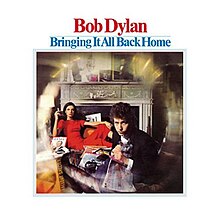
The anthology's cover,[10] photographed by Daniel Kramer with an border-softened lens, features Sally Grossman (married woman of Dylan's manager Albert Grossman) lounging in the background. In that location are as well artifacts scattered effectually the room, including LPs by the Impressions (Go on on Pushing), Robert Johnson (King of the Delta Blues Singers), Ravi Shankar (India's Master Musician), Lotte Lenya (Sings Berlin Theatre Songs by Kurt Weill) and Eric Von Schmidt (The Folk Dejection of Eric Von Schmidt). Dylan had "met" Schmidt "one day in the light-green pastures of Harvard Academy"[eleven] and would later mimic his anthology cover pose (tipping his hat) for his own Nashville Skyline four years afterward.[12] A further record, Françoise Hardy'south EP J'suis D'accord, was on the floor nearly Dylan's anxiety simply can only be seen in other shots from the same photo session, likewise equally a re-create of the Wilhelm/Baynes version of I Ching.
Visible backside Grossman is the top of Dylan'due south head from the cover of Another Side of Bob Dylan; under her right arm is the magazine Time with President Lyndon B. Johnson as "Human being of the Year" on the comprehend of the January 1, 1965 issue. At that place is a harmonica resting on a table with a fallout shelter (chapters eighty) sign leaning against it. Higher up the fireplace on the mantle directly to the left of the painting is the Lord Buckley anthology The Best of Lord Buckley. Next to Lord Buckley is a copy of GNAOUA, a mag devoted to exorcism and Beat Generation poesy edited by poet Ira Cohen, and a glass collage by Dylan called "The Clown" fabricated for Bernard Paturel from colored drinking glass Bernard was about to discard.[13]
Dylan sits forward holding his cat (named Rolling Stone)[thirteen] and has an opened magazine featuring an advertisement on Jean Harlow's Life Story by the columnist Louella Parsons resting on his crossed leg. The cufflinks Dylan wore in the picture were a souvenir from Joan Baez, equally she later referenced in her 1975 song "Diamonds & Rust". Daniel Kramer received a Grammy nomination for all-time album embrace for the photograph.
On the dorsum cover (also by Kramer), the adult female massaging Dylan's scalp is the filmmaker and operation artist Barbara Rubin.[fourteen]
Release [edit]
Bringing Information technology All Back Home was released on March 22, 1965 by Columbia Records.
The mono version of Bringing It All Back Habitation was re-released in 2010 on The Original Mono Recordings, accompanied past a booklet containing a critical essay past Greil Marcus.
A high-definition v.one surroundings sound edition of the album was released on SACD by Columbia in 2003.[15]
Reception [edit]
The release of Bringing It All Back Home coincided with the final show of a joint tour with Joan Baez. By this time, Dylan had grown far more popular and acclaimed than Baez, and his music had radically evolved from their former shared folk style in a totally unique management. It would be the last time they would perform extensively together until 1975. (She would back-trail him on another bout in May 1965, but Dylan would not inquire her to perform with him.) The timing was appropriate every bit Bringing It All Back Dwelling signaled a new era.
Dylan is backed past an electric rock and ringlet band—a move that further alienated him from some of his onetime peers in the folk music community.[ citation needed ]
The album reached No. 6 on Billboard 's Pop Albums chart, the start of Dylan'due south LPs to break into the US top ten. It also topped the UK charts afterwards that spring. The first track, "Subterranean Homesick Blues", became Dylan'due south outset unmarried to chart in the Us, peaking at #39.
Legacy [edit]
| Review scores | |
|---|---|
| Source | Rating |
| AllMusic |  [3] [3] |
| Chicago Tribune | [16] |
| Encyclopedia of Pop Music | [17] |
| Amusement Weekly | A[18] |
| Music Story |  [19] [19] |
| MusicHound Rock | 4.five/five[20] |
| The Rolling Rock Album Guide | [21] |
| Tom Hull | A[22] |
Bringing It All Back Abode is regarded equally i of the greatest albums in rock history. In 1979 Rolling Rock Tape Guide critic Dave Marsh wrote: "By fusing the Chuck Berry beat of the Rolling Stones and the Beatles with the leftist, folk tradition of the folk revival, Dylan actually had brought information technology dorsum domicile, creating a new kind of stone & roll [...] that made every type of artistic tradition available to rock."[23] Clinton Heylin later wrote that Bringing Information technology All Back Home was possibly "the nearly influential album of its era. Almost everything to come in gimmicky popular song tin be found therein."[24]
In 2003, the album was ranked number 31 on Rolling Stone magazine'due south list of the 500 greatest albums of all time, it maintained the rating in a 2012 revised list,[25] and was ranked number 181 on the 2020 list.[26]
According to Acclaimed Music, it is the 85th most historic album in popular music history.[27]
Information technology was inducted into the Grammy Hall of Fame in 2006.[28]
In a 1986 interview, movie director John Hughes cited it every bit and then influential on him as an artist that upon its release (while Hughes was still in his teens), "Thursday I was one person, and Friday I was another."[29]
The anthology was included in Robert Christgau'south "Basic Record Library" of 1950s and 1960s recordings—published in Christgau'due south Record Guide: Rock Albums of the Seventies (1981)[xxx]—and in Robert Dimery's music reference book 1001 Albums Yous Must Hear Earlier Y'all Die (2010).[31] It was voted number 189 in the third edition of Colin Larkin's book All Time Top grand Albums (2000).[32]
Hip hop grouping Public Enemy reference it in their 2007 Dylan tribute song "Long and Whining Road": "It'southward been a long and whining road, even though fourth dimension keeps a-changin' / I'1000 a bring it all dorsum habitation".[33]
Outtakes [edit]
The post-obit outtakes were recorded for possible inclusion to Bringing It All Back Dwelling.
- "California" (early version of "Outlaw Dejection")
- "Farewell Angelina"
- "If You Gotta Go, Go Now (Or Else You Got to Stay All Night)"
- "I'll Keep It with Mine"
- "You lot Don't Accept to Practise That" (titled "Angle Downward on My Stomick Lookin' West" on recording canvass)(fragment)
The raunchy "If You Gotta Get, Go Now (Or Else You Got To Stay All Night)" was issued as a single in Benelux. A unlike version of the song appears on The Bootleg Serial Volumes 1–three (Rare & Unreleased) 1961–1991. An upbeat, electric performance, the song is relatively straightforward, with the title providing much of the subtext. Manfred Mann took the vocal to #ii in the Great britain in September 1965. Fairport Convention recorded a tongue-in-cheek, acoustic French-linguistic communication version, "Si Tu Dois Partir", for their celebrated tertiary album, Unhalfbricking.
"I'll Continue It with Mine" was written earlier Another Side of Bob Dylan and was given to Nico in 1964. Nico was not nonetheless a recording artist at the time, and she would eventually record the song for Chelsea Daughter (released in 1967), only not before Judy Collins recorded her own version in 1965. Fairport Convention would besides tape their own version on their critically acclaimed 2nd album, What We Did on Our Holidays. Widely considered a potent composition from this catamenia (Clinton Heylin called it "one of his finest songs"), a consummate acoustic version, with Dylan playing piano and harmonica, was released on 1985's Biograph. An electric recording exists as well—non of an bodily take only of a rehearsal from Jan 1966 (the sound of an engineer proverb "what you lot were doing" through a command room mike briefly interrupts the recording)—was released on The Bootleg Series Volumes 1–3 (Rare & Unreleased) 1961–1991.
"Farewell Angelina" was ultimately given to Joan Baez, who released it in 1965 every bit the title track of her album, Goodbye, Angelina. The Greek singer Nana Mouskouri recorded her own versions of this vocal in French ("Goodbye Angelina") in 1967 and German ("Schlaf-ein Angelina") in 1975.
In the film Dont Look Back, a documentary of Dylan's 1965 tour of the Great britain, Baez is shown in one scene singing a fragment of the so patently still unfinished vocal "Love Is Simply A 4 Letter of the alphabet Word" in a hotel room late at night. She so tells Dylan, "If you terminate it, I'll sing information technology on a record". Dylan never released a version of the song, and, according to his website, he has never performed the song alive.
"You Don't Have to Practice That" is one of the neat "what if" songs of Dylan's mid-1960s output. A very brief recording, under a infinitesimal long, information technology has Dylan playing a snippet of the song, which he abandoned midway through to begin playing the piano.
Runway listing [edit]
All tracks are written by Bob Dylan.
| No. | Title | Recorded | Length |
|---|---|---|---|
| 1. | "Subterranean Homesick Dejection" | Jan xiv, 1965 | 2:21 |
| 2. | "She Belongs to Me" | January 14, 1965 | 2:47 |
| 3. | "Maggie's Farm" | January fifteen, 1965 | 3:54 |
| four. | "Dear Minus Nil/No Limit" | January 14, 1965 | 2:51 |
| v. | "Outlaw Blues" | January 14, 1965 | 3:05 |
| 6. | "On the Route Again" | Jan fifteen, 1965 | 2:35 |
| 7. | "Bob Dylan'due south 115th Dream" | January thirteen (intro) and January xiv, 1965 | vi:30 |
| Full length: | 24:03 | ||
| No. | Title | Recorded | Length |
|---|---|---|---|
| one. | "Mr. Tambourine Man" | January fifteen, 1965 | 5:30 |
| 2. | "Gates of Eden" | January fifteen, 1965 | five:xl |
| three. | "It's Alright, Ma (I'thousand Only Bleeding)" | January 15, 1965 | vii:29 |
| 4. | "It'southward All Over Now, Baby Blueish" | January 15, 1965 | four:12 |
| Total length: | 22:51 | ||
Personnel [edit]
- Bob Dylan – guitar, harmonica, keyboards, vocals
Additional musicians [edit]
- Steve Boone – bass guitar
- Al Gorgoni – guitar
- Bobby Gregg – drums
- Paul Griffin – piano, keyboards
- John P. Hammond – guitar
- Bruce Langhorne – guitar
- Bill Lee – bass guitar on "Information technology's All Over Now, Baby Blue"
- Joseph Macho, Jr. – bass guitar
- Frank Owens – piano
- Kenny Rankin – guitar
- John Sebastian – bass guitar
Technical [edit]
- Daniel Kramer – photography
- Tom Wilson – production
Charts [edit]
Weekly charts [edit]
Singles [edit]
Certifications [edit]
References [edit]
- ^ Hermes, Will (March 22, 2016). "How Bob Dylan's 'Bringing It All Back Habitation' 'Stunned the Earth'". Rolling Stone . Retrieved June 4, 2016.
We await back at Bob Dylan'south 'Bringing It All Back Home,' which saw him get electric, invent folk rock and redefine what tin can be said in a song.
- ^ Breihan, Tom (September 21, 2010). "Morning Benders, Mirah Pay Bob Dylan Tribute". Pitchfork.
- ^ a b Erlewine, Stephen Thomas. AllMusic Review by Stephen Thomas Erlewine at AllMusic. Retrieved June iv, 2016.
- ^ June Skinner Sawyers (May ane, 2011). Bob Dylan: New York. Roaring Forties Press. p. 77. ISBN978-0-9846254-4-4.
- ^ Woodward, Richard B. (March 18, 2015). "Dylan's Double Personality: Celebrating the 50th Ceremony of 'Bringing It All Back Domicile'". Wsj.com . Retrieved July 21, 2019.
- ^ Irwin Silber, editor of folk magazine Sing Out! described Dylan'south new music as "a freak and a parody". Bob Dylan by Anthony Scaduto, Abacus Books, 1972, p. 188
- ^ "Bob Dylan's Influence on The Beatles". AARON KREROWICZ, Professional Beatles Scholar . Retrieved Nov 10, 2016.
- ^ Heylin, Clinton, Bob Dylan: The Recording Sessions, 1960–1994, Macmillan, 1997. Cf. p.33-34 for record producer Tom Wilson's use of the 30th Street Studios for some of Dylan's work, and other references in the book.
- ^ Williams, P. (2004). Bob Dylan: Performing Creative person, 1960–1973 (2nd ed.). Omnibus Press. p. 138. ISBN978-1-84449-095-0.
- ^ https://bob-dylan.org.britain/archives/14026
- ^ Baby, Let Me Follow You Down
- ^ Humphries, Patrick (1995). The Complete Guide to the Music of Bob Dylan. London, England: Charabanc Press. ISBN0-7119-4868-2.
- ^ a b Robert Shelton: No Direction Dwelling: ISBN 0-14-010296-5
- ^ Hale, Peter. "Barbara Rubin (1945–1980)". The Allen Ginsberg Project.
- ^ "Columbia Releases 15 Bob Dylan Albums on Hybrid SACD". September 16, 2003.
- ^ Kot, Greg (Oct 25, 1992). "Dylan Through The Years: Hits And Misses". Chicago Tribune . Retrieved January 10, 2017.
- ^ Larkin, Colin (2011). "Bob Dylan". Encyclopedia of Popular Music (fifth ed.). Omnibus Press. ISBN978-0-85712-595-8.
- ^ Flanagan, Bill (March 29, 1991). "Dylan Catalog Revisited". EW.com. Retrieved Baronial 29, 2012.
- ^ "Bringing It All Back Home". Acclaimed Music. Archived from the original on June 28, 2016. Retrieved January 11, 2017.
- ^ Graff, Gary; Durchholz, Daniel, eds. (1999). MusicHound Rock: The Essential Album Guide (2d ed.). Farmington Hills, MI: Visible Ink Printing. p. 371. ISBN1-57859-061-two.
- ^ Brackett, Nathan; Hoard, Christian, eds. (2004). The New Rolling Stone Album Guide. New York, NY: Fireside. p. 262. ISBN0-7432-0169-8 . Retrieved Baronial 22, 2015.
- ^ Hull, Tom (June 21, 2014). "Rhapsody Streamnotes: June 21, 2014". tomhull.com . Retrieved March 1, 2020.
- ^ Smith, Chris (2009). 101 Albums that Changed Popular Music. Oxford: Oxford Academy Printing. p. 31. ISBN978-0-19-537371-four.
- ^ Heylin, Clinton (2011). Bob Dylan: Backside the Shades: The 20th Anniversary Edition. faber and faber. p. 181. ISBN978-0-571-27240-2.
- ^ "500 Greatest Albums of All Time Rolling Stone's definitive list of the 500 greatest albums of all time". Rolling Rock. 2012. Retrieved September 23, 2019.
- ^ "Bringing Information technology All Back Dwelling house ranked 181st greatest album by Rolling Stone magazine". Rolling Stone. September 22, 2020. Retrieved Dec 8, 2020.
- ^ "Bringing It All Back Home ranked 85th greatest album". Acclaimed Music . Retrieved December viii, 2020.
- ^ "Grammy Hall of Fame Letter B". Grammy. Oct eighteen, 2010. Retrieved Baronial twenty, 2021.
- ^ Ringwald, Molly. "Molly Ringwald Interviews John Hughes". Seventeen Magazine. Leap 1986. The John Hughes Files. Archived from the original on Baronial 9, 2009. Retrieved February 25, 2010.
- ^ Christgau, Robert (1981). "A Basic Record Library: The Fifties and Sixties". Christgau'south Record Guide: Rock Albums of the Seventies. Ticknor & Fields. ISBN0-89919-025-1 . Retrieved March 16, 2019 – via robertchristgau.com.
- ^ Robert Dimery; Michael Lydon (March 23, 2010). 1001 Albums You Must Hear Before You Die: Revised and Updated Edition. Universe. ISBN 978-0-7893-2074-2.
- ^ Colin Larkin, ed. (2000). All Time Top m Albums (tertiary ed.). Virgin Books. p. 98. ISBN0-7535-0493-6.
- ^ Public Enemy – The Long and Whining Road , retrieved April 12, 2021
- ^ a b "Bob Dylan | Artist". The Official Charts Visitor. Retrieved Baronial 20, 2012.
- ^ a b c Bringing It All Back Home – Bob Dylan: Awards at AllMusic. Retrieved August twenty, 2012.
- ^ "British anthology certifications – Bob Dylan – Bringing It All Back Home". British Phonographic Industry.
- ^ "American anthology certifications – Bob Dylan – Bringing Information technology All Back Domicile". Recording Industry Association of America. Retrieved August xx, 2012.
Source: https://en.wikipedia.org/wiki/Bringing_It_All_Back_Home
0 Response to "Lords She Belongs to Me on the Road Again"
Post a Comment